Blood Letting & Sugar Readings
The art of taking blood and reading your sugar levels
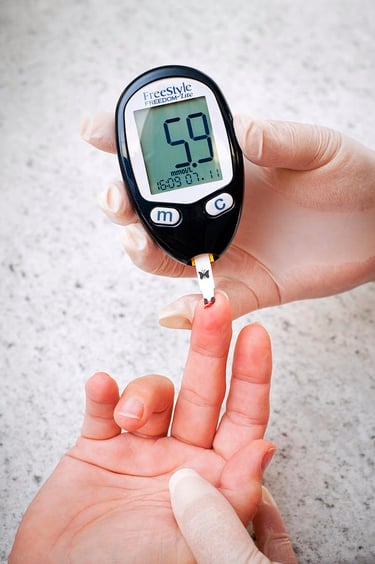
Bloodletting for Beginners (a.k.a. The Daily Diabetic Ritual)
Do you remember when I told you about Vampirella, the blood-letting nurse? The one who can’t get blood out of a stone - namely, me!
Well, welcome back to another cheerful diabetic self-help task: checking your own blood sugar and writing the bloody results down. Who’s a cilever puppy then?
A Very Quick History Lesson
Back in the Bad Humours Era - The Middle Ages onwards - people genuinely believed that draining blood cured just about everything. Got a headache? Bloodletting. Are you feeling tired? Bloodletting. Stubbed your toe? Er! … Bloodletting.
They were, of course, gloriously wrong.
That said, the idea that blood holds answers wasn’t entirely daft. Fast forward a few centuries and here we are, diabetics still bleeding for answers - only now it’s a pinprick instead of a knife stab and a droplet on a test strip, instead of a pint of the old red life juice. In a bucket.
Frankly, Vampirella would have thrived back then.
Once upon a time, if you felt a bit peaky, you’d visit the local quack, or barber - usually a man with an outrageously impressive moustache, he'd happily drain a jug of blood from you. But, if things were really serious, you got the leeches.
Please don’t start me on the leeches.
Modern Bloodletting (Now with Technology)
Thankfully, those days are mostly behind us. But if you’re diabetic, we still practice a modern, sanitized version of bloodletting.
Instead of a bucket, it’s a test strip. Instead of a moustachioed barber, it’s a little plastic meter that judges you silently.
For the uninitiated, here’s the daily ritual:
Grab the lancing device (which sounds dramatic, but is really just a spring-loaded toothpick).
Give your poor fingertip a jab.
Squeeze out that precious red life juice like it’s liquid gold.
Feed it to the machine and await judgment.
And just like that, you know whether you’re being sensible, spiking higher than a moon rocket, or heading for a diabetic hangover low that feels like you’ve run a marathon in a sauna.
Simple, really.
Stab. Squeeze. Read.
When It Gets Weirdly Normal
Here’s the odd bit: you can jab yourself six times a day without blinking… yet the moment a nurse approaches with a hypodermic needle (hello again, Vampirella), you revert instantly to a babbling toddler.
Explain that to me.
And let’s be honest - sometimes the results feel personal. Did my blood sugar really shoot up to 14, just because I looked at a kebab house? Or did hoovering the living room really drop me into a hypo?
My meter doesn’t just give numbers. It gives me attitude.
The Silver Lining
All jokes aside, these little finger pricks are lifesavers. They give us the information we need to stay upright, make better choices, and stop diabetes from running the show.
It’s not glamorous. Yes, your fingertips end up looking like tiny pincushions. But it still beats the barber-surgeon option. Or the leeches. Or Vampirella.
So next time you jab your finger, remember: you’re continuing a centuries-old tradition of bloodletting. Just with more Wi-Fi and fewer buckets.
Maybe one day we’ll just blink at a gadget and get a hologram readout. Until then, we’ll keep stabbing and trying not to get blood on the legs.
So… What Could Possibly Go Wrong?
It’s me we’re talking about. And frankly! Most of the male diabetic population of the world too.
For a start, men do not read instruction manuals. We instinctively know everything. Everybody knows that.
After attempting to shove the batteries into the wrong end of the meter, I finally get them in properly. In the correct end. The screen lights up like a demented pocket calculator, then settles on zeros.
"Woo hoo! I've cracked it."
Next: the spring-loaded, toothpick stabber thing.
Where does the blue pointy thing go? Twenty minutes later - after unscrewing, re-screwing, and swearing - it’s primed and ready.
Now for the strip. Damn it. I need the manual.
The instructions say: insert strip, prick finger (index finger is best), squeeze until blood appears, wait for the bleep.
Marvellous.
I insert the strip. Put the meter down. Pick up the stabber. Stab the Index finger - The manual said so. "So where's that bloody trigger gone?"…
Cudunk.
Nothing.
No pain. No blood. No nothing. I check the pin is in there. Yep! Then
I notice some numbers on the pen. It's set to zero. Hmm! I turn it to number 5 and reload.
Cudunk.
"Owwww. That hurt. A lot."
I squeeze and a torrent of red life juice shoots down on to my leg.
Note to self: number 5 is too bloody high. And too bloody painful."
I repeat. A splodge of blood drops onto the strip and I wait for the bleep.
Nothing.
"This machine is bloody useless." I say to the stabber." I re-read the manual.
I had put the strip in upside down.
Another strip inserted. The correct way round. I Squeeze my finger... I wait... Nothing - it had already healed. "Damn."
Click - another stab. Not number 5 this time. Let’s say… 3.
Cudunk.
Ouch, but survivable.
Blob of blood. BEEP! Numbers appear.
Over a hundred.
A hundred?! I should be dead. It’s meant to be between 6 and 14.
Back to the manual.
Ah. Two formats. UK/EU and USA. American numbers run over a hundred.
Change setting.
Which means… yes… another stab. At least Vampirella isn't here.
Cudunk.
Ow.
It reads 17.
Should I be in hospital?
A quick trip to the InterWeb. Nope - I just need to cut the sugar down.
Becoming a Professional Stabber
Eventually, even us morons learn. We discover that with five fingers, two sides, and a top on each digit, we’ve got 15 possible stab points per hand.
It saves drilling down into the same sore spot every time like a lunatic.
And just like that…
Woo hoo. I’m an expert.